If you run a business with more than one brand, product line or sub-brand, you already have a brand architecture. You might not call it that. You might call it “a bit of a mess”. Either way, the structure exists. The only question is whether it was designed, or whether it just happened.
Brand architecture is one of those frameworks that you'd wished you had known about earlier. It becomes the most practical thing in the world, because without it, every new product launch, acquisition or market expansion creates more confusion than clarity.
Brand architecture is the organising structure of a company’s brands, sub-brands, products and services. It defines how they relate to one another, and how those relationships are presented to customers.
What is Brand Architecture?
Think of it as the family tree of your brand. Just as a family tree shows how people are related, brand architecture shows how your brands relate to one another. It answers the questions customers, employees and partners are already asking, whether you’ve given them answers or not. Does this product belong to that company? Are these two brands related? If I trust brand A, should I trust brand B?
Without a deliberate architecture, those questions get answered by accident or at least unintentionally. And accidental answers are rarely good ones.
Here’s the part that matters most, and the part that gets missed: brand architecture is a customer-perception decision, not an org-chart decision. A brand lives in the minds of your customers, not in your asset register, and the structure connecting your brands lives in exactly the same place. Yet we regularly see structures recommended because they mirror how the company is organised internally: business groups, ownership entities, operational divisions. It all makes perfect sense in the boardroom. Nobody has asked whether the customer benefits from any of it.
The customer doesn’t care how your business is structured. They care whether they can make sense of what you’re offering them.
Why Brand Architecture Matters
Here’s where most businesses get into trouble. They grow organically. They launch a new service line here, acquire a company there, create a sub-brand for a specific market. Each decision makes sense in isolation. Zoom out and you’ve got a portfolio that looks like it was designed by committee, because it was.
The result: customers can’t tell your brands apart. Your team can’t explain how everything fits together. Marketing spend gets fragmented across too many brands, none of which gets enough investment to build real recognition. And every new addition makes the problem worse.
Brand architecture turns those reactive decisions into strategic ones. It creates a brand architecture framework: deliberate rules that guide how brands are created, named, positioned and presented, and just as importantly, it sets the rules for how future brands get added. That last part is the difference between an architecture and a diagram. A structure without rules drifts back into chaos within eighteen months.
It matters most at moments of change: a merger or acquisition, entry into a new market, a new product at a different price point, or a shift in business strategy. It’s why corporate brand architecture work clusters around restructures and deals. These are the moments where the architecture decision compounds your brand equity or quietly dilutes it.
The Three Types of Brand Architecture
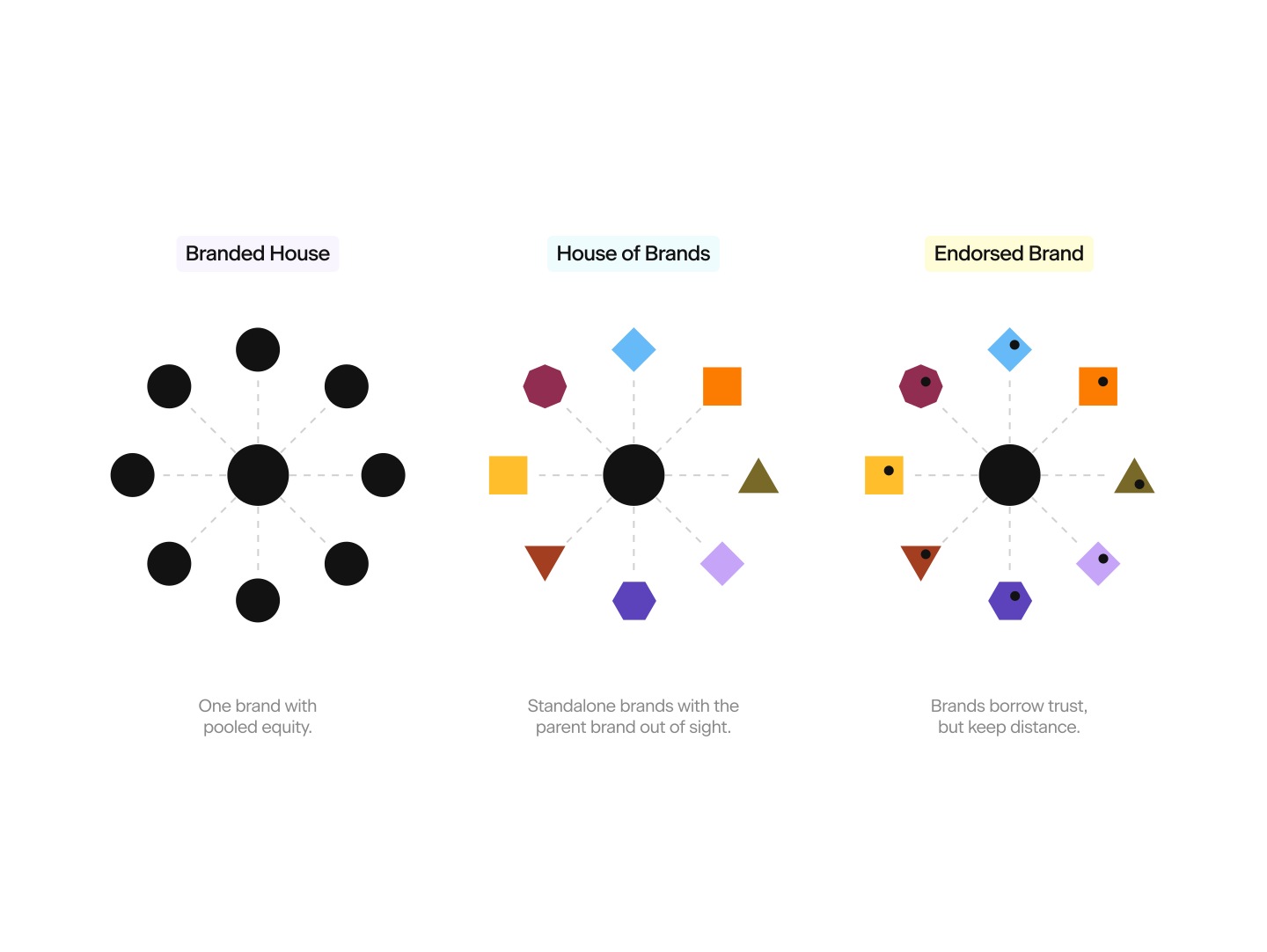
There are three primary brand architecture models. You’ll see other counts elsewhere: five-type breakdowns that split out sub-brands, and three-type breakdowns that fold the endorsed model into a “hybrid” category. We hold at branded house, house of brands and endorsed, because sub-brands are a variation of a branded house, and hybrid isn’t a model. Hybrid is what happens when you use the models as thinking tools rather than boxes to climb into, which is exactly what they are.
Branded House
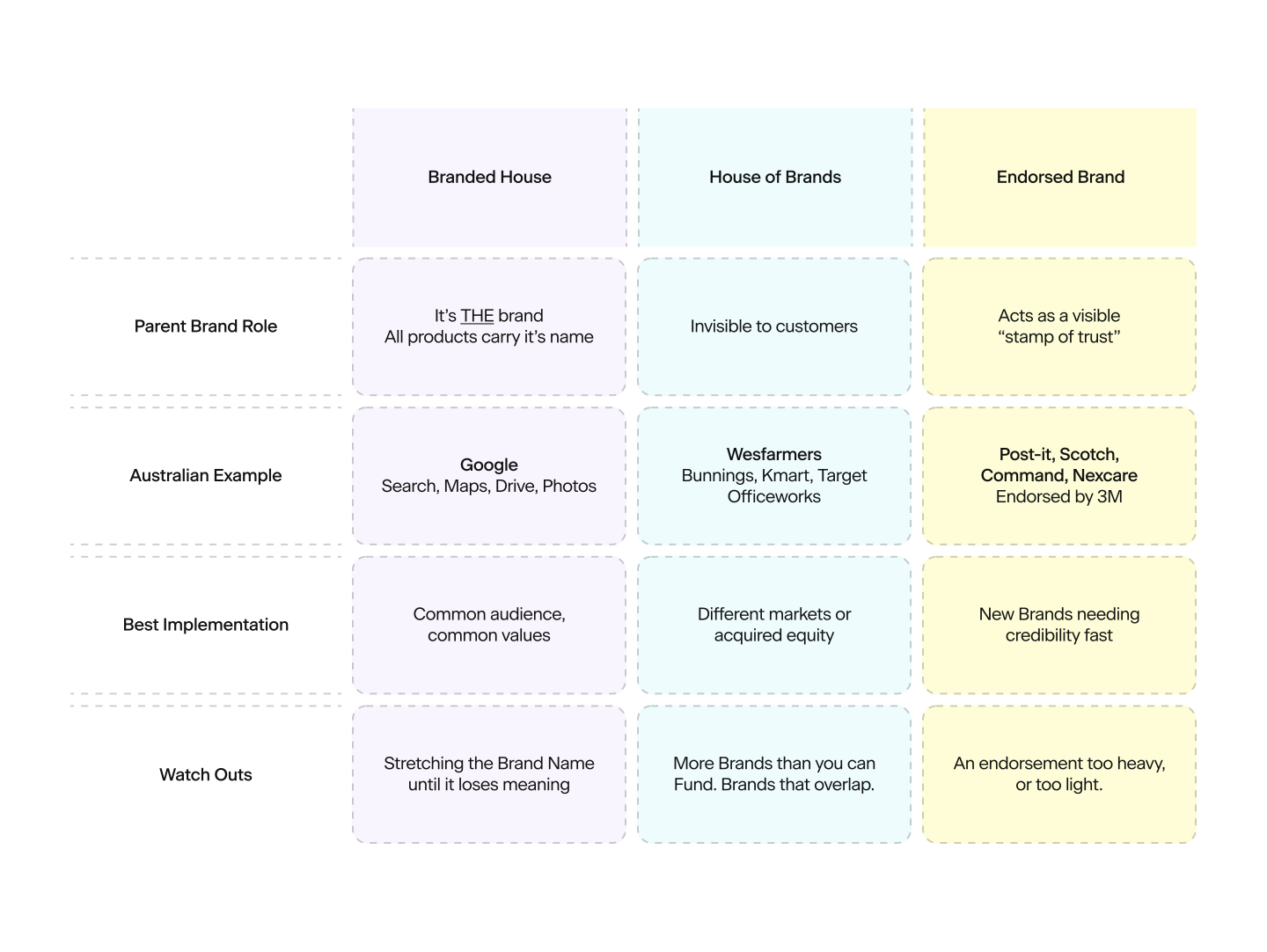
One master brand sits at the top and everything falls under its umbrella. Sub-brands or products carry the parent name, sometimes with a descriptor.
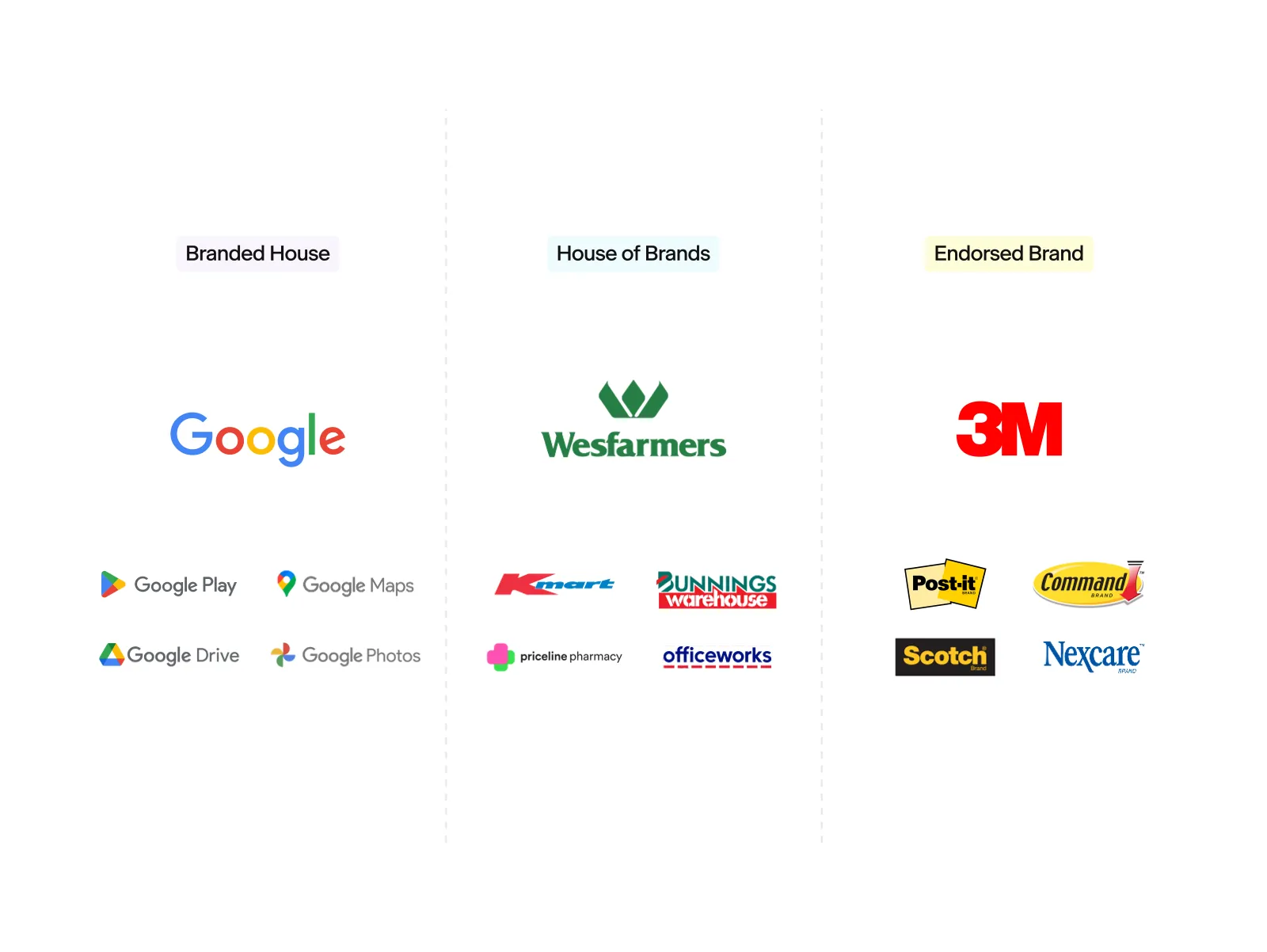
Google is the shorthand example: Search, Maps, Drive and Cloud all borrow the parent’s credibility, and every new product launches with trust already in the bank.
The advantage is efficiency. You’re building one brand, not ten. Marketing investment compounds rather than fragmenting, and awareness for the parent lifts every product in the portfolio.
The risk runs the other way too. If one product fails or picks up negative associations, the whole brand wears it. And if you operate in markets with very different customer expectations, a single brand can stretch until it means nothing.
A branded house works best when your products share a common audience and common values, and the parent brand is strong enough to cover the portfolio without losing meaning.
House of Brands
The opposite approach. Each brand stands on its own with its own identity, positioning and audience. The parent operates behind the scenes, often invisible to the customer.
The textbook example is Procter & Gamble, but there’s a better one in every Australian shopping strip. Wesfarmers owns Bunnings, Kmart, Officeworks and Priceline. Most customers have no idea these brands share a parent, and that’s the point. Each brand owns its own territory, its own relationship with its customers, its own equity. The Wesfarmers name exists for investors, not shoppers.
The advantage is focus. Each brand can target a specific market without being constrained by the parent’s associations, and trouble at one brand doesn’t spread to the others.
The downside is cost. Every brand needs its own marketing investment, its own awareness building, its own equity development. There’s no parent to borrow trust from. Running several independent brands properly takes serious organisational capability, and as we’ll get to shortly, this is where most portfolios quietly fall apart.
A house of brands works best when your offerings serve fundamentally different markets, when brand associations need to stay separate, or when you’ve acquired brands with strong equity of their own.
Endorsed Brand
The middle path. Individual brands have their own identity and positioning, but carry a visible endorsement from the parent: “by”, “backed by”, “part of”.
ubank is a clean Australian example. It runs its own identity, product and voice aimed at self-directed digital banking customers, while stating plainly that it’s part of NAB. The endorsement does one job: it transfers trust. You might not know this brand, but you know who stands behind it. Marriott runs the same play at global scale, with Courtyard and Residence Inn each carrying the parent’s name as a quality floor.
The risk is balance. Lean too hard on the endorsement and the sub-brand never develops a personality of its own. Hide it too well and you’ve paid for a house of brands while pretending you haven’t.
Most Real Architectures Are Hybrids
Very few companies fit neatly into one model, and the best brand architecture examples prove it: the portfolios that look like one model usually run several at once.
Qantas Group is the proof. Qantas operates as a branded house internally: QantasLink, Qantas Freight, Qantas Frequent Flyer. Then in 2004 it launched Jetstar as a standalone brand to fight Virgin Blue on price. That was a deliberate architecture decision, not a branding exercise. A budget airline carrying the Qantas name would have dragged the premium brand down with every $49 fare. A separate brand could compete at the bottom of the market while Qantas held the top. One company, three models, each chosen for a reason.
That’s the real question brand architecture answers. Not “which model are we?” but “what relationship should each brand have with the parent, and why?” The relationship should be driven by what the customer needs to know, not by organisational convenience. If the customer benefits from knowing two brands are related, make the connection visible. If they don’t, let them stand apart.
A House of Brands, Built Deliberately: Brew Society
Our client Brew Society shows what this looks like in practice, because their architecture is the opposite of what the org chart would suggest.
Brew Society has genuine reputation and equity, but it lives in B2B hospitality. In consumer categories, that equity is worth almost nothing. A cafe owner choosing a supply partner knows the name. A shopper standing in front of the oat milk shelf has never heard of it, and wouldn’t buy differently if they had.
So when the business moves into consumer categories, it doesn’t extend the parent brand. It builds challengers. Special Friends competes in oat milk. Fredericks competes in coffee. Underneath the same parent sit Benchmark Consolidated and Spread Finance, each built as its own brand for its own market.

The logic is worth spelling out, because it’s the same logic any multi-brand business should be running:
These categories are product-led. In competitive consumer markets, people buy the product, not the corporate parent. The consumer’s mind treats the brand and the product as the same thing. A specific product for a specific person in a specific market gets cut-through. A stretched parent brand gets ignored.
The parent has a ceiling. Every brand can only extend so far before it starts watering down what it means. Brew Society will keep expanding into new categories over time, and the architecture is built for that: standalone brands can be added, tested and repositioned without the parent absorbing the risk.
Independence buys experimentation. A standalone challenger can chase a sharp position, change course, or lean into an attitude the parent never could. That freedom is a strategic asset in categories where distinctiveness is the whole game.
This is a house of brands, chosen deliberately. Not because the models said so, but because of how customers in each category actually decide. That’s the test your own architecture should pass.

When Brand Architecture Goes Wrong
Architecture mistakes don’t look like mistakes at first. They look like growth. Then the bill arrives, and it can take a decade.
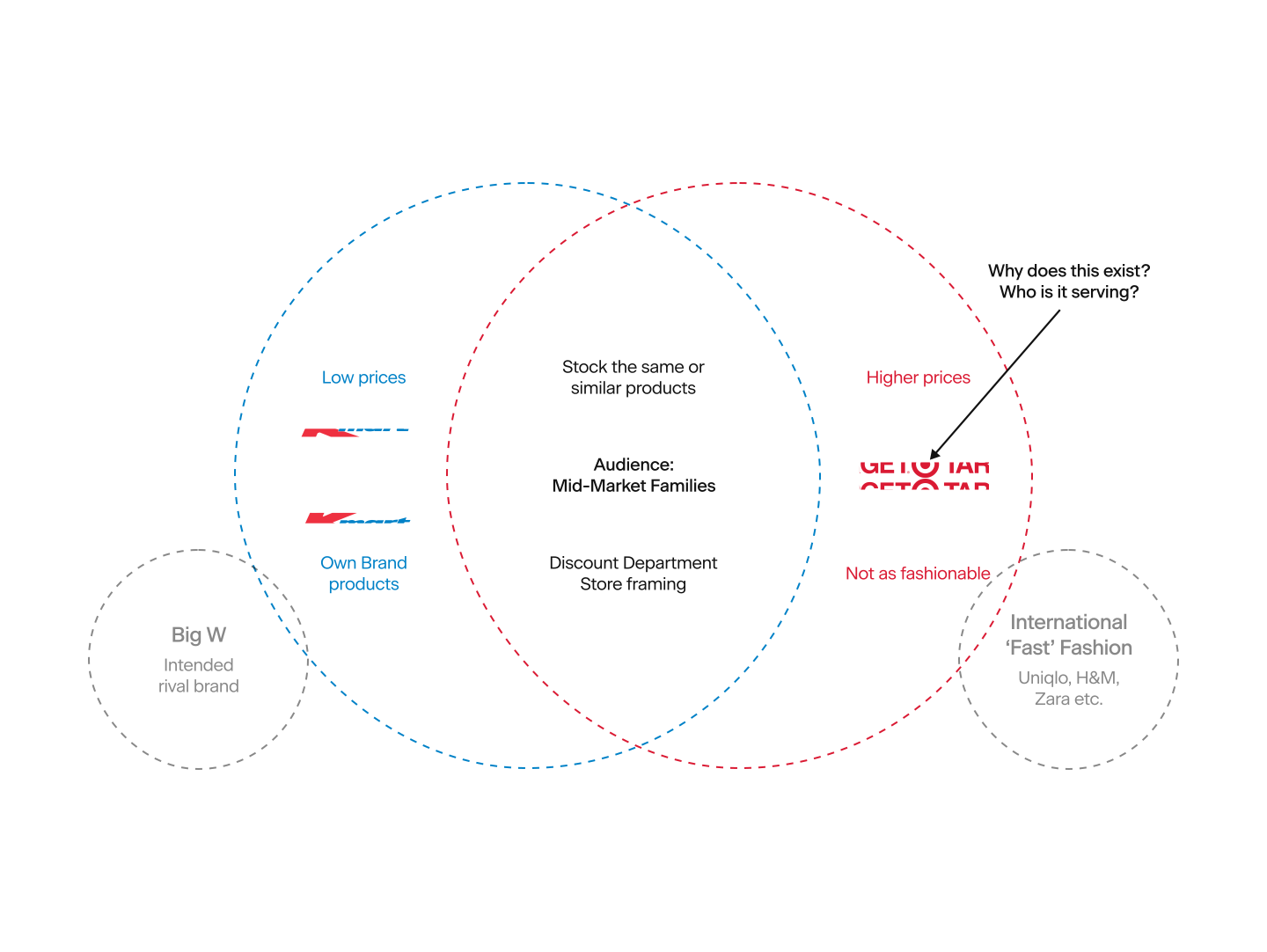
The clearest Australian example is Kmart and Target. Wesfarmers inherited both in its 2007 acquisition of Coles Group: two discount department stores, one parent, chasing broadly the same mid-market family. On paper, a house of brands. In practice, two brands without a clear answer to the only question that matters: what is each one for, that the other isn’t?
From 2008, Kmart repositioned hard around lowest prices and own-brand product, and it worked spectacularly. Target sat awkwardly in the middle: not as cheap as Kmart, not as fashionable as the international arrivals. Customers came to see it as a slightly more expensive Kmart, which is another way of saying they saw no reason for it to exist. If people can’t see how you’re different from the alternatives, you’re comparable, and comparable means replaceable. Target’s closest alternative was its own sibling, and the parent was funding both sides of the fight.
In May 2020, Wesfarmers pulled the pin: up to 167 of Target’s 289 stores slated for closure or conversion, 92 of them becoming Kmarts, restructuring costs of $120 to $170 million plus another $120 to $140 million the following year, and up to 1,300 jobs gone. The failure wasn’t Target’s logo or its marketing. It was a portfolio question nobody answered until the market answered it for them.
You don’t need a $30 billion portfolio to make the same mistake. The version we see most often is a business with too many brands and not enough resources to run them. On paper the structure looks like a great idea. In reality, the marketing budget, the team and the founder’s attention get spread so thin that none of the brands gets the work it needs. You end up with a house of brands that people aren’t aware of, didn’t know existed, or just find confusing.
It shows up most in services businesses: a brand per service line, a brand per industry, a brand per price point. That can work, but only with genuinely clear delineation. If two of your brands are speaking to the same customer in slightly different ways, you’re not segmenting the market. You’re competing with yourself, at double the cost.
Which leads to the most useful default in all of brand architecture: create products, not brands. Not every new offering needs its own brand. A product name or a service line inside an existing brand is usually more effective and dramatically cheaper to run. Extend what you have unless there’s a compelling strategic reason not to. Our general advice for smaller businesses is exactly that: keep it under a single entity, structure the offering within it, and let the existing brand’s equity, discoverability and cross-sell do the work.
How to Develop a Brand Architecture Strategy
If your portfolio needs structure, this is the sequence for designing your brand architecture.
Start with an audit of what you have. Map every brand, sub-brand, product name and service line. Note how each is positioned, who it targets, and how it relates (or doesn’t) to the parent. This exercise alone usually reveals the mess. A brand audit is the formal version of this step.
Define your strategic intent. What is the business trying to achieve over the next three to five years? Consolidating around a core offering, diversifying, acquiring, or preparing parts of the business for sale? That last one matters more than people admit: a unit that shares the parent’s name is hard to sell, while a standalone brand carries its own equity out the door. The architecture has to serve where the business is going, not describe where it’s been.
Assess the equity. Not all brands in a portfolio are equal. Some have real recognition and loyalty, others are unknown or carry baggage. Understanding where the brand equity actually sits tells you which brands to invest in, which to merge and which to retire. Be honest here: clients routinely over-invest in brands they own that create no real value, simply because they own them.
Choose the structure, customer-first. Work through the alternatives properly. There will always be more than one way to build it, and the most obvious structure is not always the best one. For each option, ask how customers in each category actually decide, whether the parent’s equity means anything to them, and what the structure costs to operate. Then decide what relationship each brand should have with the parent, and why.
Write the rules down as brand architecture guidelines. Naming conventions, visual hierarchy between parent and sub-brands, when to create a new brand versus extend an existing one, and who decides. Guidelines are what stop the next opportunistic launch from undoing the whole exercise.
Review it as the business changes. Architecture isn’t set-and-forget. What works for a five-product portfolio won’t survive fifteen. Revisit it annually, and at every major strategic shift.
Do You Actually Need Brand Architecture?
Honestly: maybe not yet.
If you’re a small business with one brand and a handful of products, you can probably skip this entirely. Running multiple brands as a small operator is usually a way of spreading yourself too thin, spending your most limited resources (time, money, attention) building brands that aren’t clearly defined and aren’t creating value.
One caveat. Some small businesses deliberately run experiments: testing offers, audiences and positions to find what gets traction. If that’s your strategy and you’re doing it intentionally, brands can be part of the experiment. The problem isn’t multiple brands. It’s unintentionally chasing opportunities until you’re unfocused.
Architecture becomes important at a specific moment: when an opportunity stops fitting naturally inside your primary brand. A different customer, a different price point, a different use case, where pursuing it under the main brand would damage what the main brand means. That’s the trigger. Jetstar existed because a $49 fare doesn’t fit inside Qantas. Special Friends exists because oat milk doesn’t fit inside a B2B hospitality brand.
One more thing worth knowing: some architectures exist only internally, as a way for the team to make sense of how business units relate, while the customer sees a single brand. That’s a legitimate outcome. The customer doesn’t need to see your structure. They need to see clarity.
There’s no hard rule about size or complexity. It’s case by case: your goals, your market, and how your customers make decisions.
What Does Brand Architecture Cost?
Brand architecture is rarely a standalone engagement. It’s part of brand strategy work, and the moment of maximum relevance is usually a rebrand or portfolio restructure, where comprehensive work covering strategy, identity and guidelines starts from $30,000 and runs to $100,000 or more.
The honest cost driver is the number of brands. Structuring the portfolio is one decision. But every unit in the structure still needs its own positioning, messaging and identity work, so a five-brand architecture isn’t slightly more work than a two-brand one. It’s more than twice the work, forever, because the operating cost never goes away. Which is one more argument for fewer brands.
Brand Architecture Diagram
A brand architecture diagram is the visual output: parent at the top, sub-brands, product brands and service lines arranged beneath, with the nature of each relationship made visible. Which brands are endorsed, which stand alone, which share identity elements.
A useful diagram is a map, not an org chart. Simple enough to read at a glance, detailed enough to guide real decisions. If it needs a legend with twenty symbols, it’s too complex. If it’s names in boxes with lines between them, it isn’t telling you anything.
Brand Architecture and Brand Strategy
Brand architecture doesn’t exist in isolation. It’s one component of a broader brand strategy, and one of the most consequential, because it determines how equity flows across the portfolio.
Strategy, as we’ve defined it across this series, is a breakdown of the current situation, a hypothesis of winning and a set of integrated choices that support it. Architecture is one of those choices, and it has to integrate with the rest. If your brand positioning defines where each brand sits in the market, your architecture defines how those positions relate. If your differentiation strategy determines what makes each brand distinct, your architecture determines whether that distinctiveness is amplified by the parent or protected from it. And if your brand naming conventions decide what each brand is called, your architecture decides how those names sit together. A structure that contradicts the positioning isn’t a neutral admin decision. It’s a choice pulling against the others, and the seesaw tips back toward the middle.
Get the architecture wrong and it undermines everything else. You can have brilliant individual brands with sharp positioning, and customers still won’t experience them the way you intended, because the system connecting them is confused.
Does Your Brand Architecture Need Attention?
A few signs worth taking seriously. Your sales team struggles to explain how your brands relate. Customers regularly confuse your brands, or don’t realise they’re connected. You’re actively investing in brands that aren’t building on any existing equity. Every new launch triggers a naming and branding debate that feels like starting from scratch. Or your brand guidelines have nothing to say about how sub-brands sit alongside the parent.
If any of those sound familiar, the individual brands might be fine. The system connecting them is what needs fixing.
Ready to bring structure to your brand portfolio? Explore our brand architecture service.
Brand architecture is the organising structure that defines how a company's brands, sub-brands, products and services relate to one another and how they're presented to customers. It determines whether brands operate under a single master brand, independently, or with endorsement from a parent brand.
The three primary brand architecture types are: branded house (one master brand with sub-brands beneath it, like Google), house of brands (independent brands owned by a parent company, like Procter & Gamble), and endorsed brand (independent brands with parent brand endorsement, like Marriott). Most real-world architectures are hybrids of these three models.
In a branded house, one master brand sits at the top and all products carry its name (like Google Search, Google Maps). In a house of brands, each brand stands independently with its own identity and the parent company is often invisible to customers (like P&G owning Tide, Gillette and Pampers). A branded house is more cost-efficient but carries more risk if one product fails, while a house of brands offers flexibility but requires significantly more marketing investment.
Developing a brand architecture strategy involves six key steps: audit your existing brand portfolio and map all brands and sub-brands, define your strategic intent for the next three to five years, assess where brand equity sits across the portfolio, choose the right architecture model or hybrid, create brand architecture guidelines that document naming conventions and visual hierarchy, and implement with regular reviews to evolve the architecture as the business grows.
A brand architecture diagram is a visual representation of how a company's brands relate to one another. It shows the hierarchy from parent brand down to sub-brands and products, the nature of relationships between brands (endorsed, independent, shared identity), and the relative importance of each brand in the portfolio. A good diagram functions as a decision-making map, not just an organisational chart.
A business needs brand architecture when it has more than one brand, product line or sub-brand. Key signs include: your team struggles to explain how brands relate, customers confuse your brands, every new product launch triggers a debate about naming and branding, or your marketing spend is fragmented across too many brands. It's especially critical during mergers, acquisitions, new market entry or product diversification.
Five-type models usually list branded house, sub-brands, endorsed brands, house of brands and hybrid. We hold at three. Sub-brands are a variation of a branded house: the parent name still leads and the descriptor follows. Hybrid isn't a model either, it's what happens when a company runs different models for different brands, which most large portfolios do. Qantas is a branded house that also runs Jetstar as a standalone brand. The useful question is never which of the five you are. It's what relationship each brand should have with the parent, and why.
Most of the time. Create products, not brands. A new offering only needs its own brand when it stops fitting inside your primary brand: a different customer, a different price point or a different use case, where selling it under the main brand would damage what that brand means. Jetstar exists because a $49 fare doesn't fit inside Qantas. If the new thing shares your audience and your values, a product or service name inside the existing brand is cheaper to run and inherits equity you've already paid for. Every extra brand is another website, another budget and another team, forever.

Marcel McCarthy is the Creative Director at ONETOO. He helps ambitious brands turn strategy into clarity — and clarity into action. Known for asking hard questions, dodging trends, and making bold ideas feel obvious (in hindsight).