If a brand is really just an idea, is a rebrand just about changing that idea?
As a definition, rebranding is the process of deliberately changing how a business is perceived: it's a strategy to reposition its identity, messaging and visual system to where the business is going. It can be as light as a refresh or as significant as a new name. It can revolutionise a brand that has stopped connecting with it's audience and team, or claim new ground competitors haven't seen yet.
That's the short answer.
The longer answer when considering a rebrand? Covering when to do it, what it costs, how long it takes, and why so many rebrands fail.
Starting off, there are two moments that lead a business here. The first is when the brand stops fitting: the market has shifted, you've outgrown what you started as, or customers describe you differently to how you describe yourself. The second is rarer and more valuable: nothing is broken, but you can see where the market is moving before your competitors do, and the brand is how you get there first. Either way, the difference between a rebrand that transforms a business and one that wastes months comes down to one thing: understanding what problem you're actually trying to solve for.
What is Rebranding?
Rebranding is the process of changing how a business engages the world. That might include a new name, a new visual identity, a new brand strategy, a new voice, or all of the above. At its core, rebranding is about shifting perception: sometimes closing the gap between who you've become and how people see you, sometimes opening a gap between you and the market by moving first.
The rebranding meaning gets muddied because people use the word for everything from a logo refresh to a complete business reinvention. A restaurant changing its menu font and a tech company renaming itself mid-pivot might both call it a "rebrand," but they're fundamentally different exercises. In practice, rebranding means deciding that your current brand (the sum of your identity, positioning, messaging and visual system) no longer serves where the business is going, and then building something with clear strategic intent that does. And because a brand is a promise as much as an image, that decision can reach past communication into how the business actually delivers.
A New Logo Is Not a Rebrand
A logo change is a logo change. A redesign is a redesign. A name change is a name change. None of them, on their own, is a rebrand.
A brand isn't a logo. It's an idea that lives in the minds of your customers, in the accumulated associations built up over thousands of interactions with your business. Rebranding means changing those associations. Some of the most effective repositioning work in history barely touched the logo, because the real change happened in what the business did, said, sold and stood for.
If your associations are the problem, new colours won't fix them. If your strategy is the problem, a new name is just the old confusion wearing a new outfit. The visual identity is the last mile of a rebrand, never the starting point.
Start With the Diagnosis, Not the Brand
This is the question most agencies skip. A client arrives saying "we need a rebrand," and the agency says "great" and rolls out the standard process. What almost nobody does is stop and ask: why do you think you need one?
The most dangerous moment in any rebrand happens before the project starts, at diagnosis. Problem identification sets the direction for the entire process, and ultimately determines what the brand becomes. Misdiagnose at the start and everything downstream inherits the error.
When a business feels like its brand isn't working, the actual problem usually falls into one of three categories:
Technical problems. The brand literally doesn't function across the channels and scales the business now operates in: a logotype that works on signage but falls apart as a social media avatar, or a colour palette that fails accessibility standards. Real problems, but production problems, and they rarely justify a full rebrand on their own.
Relevance problems. The services have expanded and the name or brand refers to something that's no longer true. The business has outgrown its own label.
Strategy problems. The brand no longer helps the business compete. The positioning is contested, the category has shifted, the customer's alternatives have changed.
Each calls for a different intervention. And the question isn't just "is there a problem?" but "is this a problem worth solving, one that creates real value when fixed?" A rebrand is an expensive way to solve a problem you might have.
There's also a fourth possibility, and it reframes the whole exercise: no problem at all. Some of the most valuable rebrands are offensive moves. Getting ahead of a market shift competitors haven't seen yet. Claiming a category before it exists. Repositioning while you're strong rather than waiting until you're forced to. The diagnosis question then changes from "what's broken?" to "what's the opportunity worth, and are we positioned to take it first?"
A good diagnosis also protects you from insularity. A lot of brand strategy is inward-looking: this is who we are, this is what we do, these are our values. Those things matter, but strategy is ultimately about how you compete in the marketplace, where your customers are and what they see as valuable. In low-interest categories, your carefully crafted values statement carries less weight than you'd hope. In high-interest categories, it can be a superpower. Know which game you're playing before a single design decision gets made.
A Rebrand Is a Promise the Business Has to Keep
Everything so far has been about perception, positioning and identity. Here's the risk in stopping there: a rebrand that only touches the visual and verbal layer, the logo, the messaging, the campaigns, is the expected version. And it quietly assumes the business behind the brand is already delivering.
Often it isn't, quite. Businesses drift. What a company does internally and how it presents itself publicly separate over time, usually without anyone deciding it. The brand makes one promise while the operation keeps another.
If a brand is an idea in someone's head, the product or service either confirms that idea or contradicts it. Apple is the reference everyone reaches for on storytelling and marketing, but the reason the story works is that opening an iPhone confirms it. If the advertising set an expectation and the product arrived in complete contrast, the promise would break, and a broken promise frustrates people more than a modest one ever could. The same logic applies at the unglamorous end: a luxury fashion brand whose stitching fails doesn't have a communications problem. No image survives a garment falling apart.
Sometimes a visual overhaul genuinely is all that's needed, and an honest diagnosis will tell you so. But you can't expect a visual-only outcome to shift a business whose philosophy and delivery are misaligned with the promise. The best advertising in the world can't outrun a product that doesn't do what it claims, because the product is what people are actually buying. Perhaps you could call this brand integrity.
The more thoughtful version of a rebrand treats it as a strategic alignment tool. Alongside the identity and messaging work, it asks what needs to shift inside the organisation: the values, priorities and behaviours that shape how the service is delivered and how value is created, so that what you communicate and what people experience are the same thing. Handled this way, a rebrand becomes an inflection point. Not just "how should we look and sound?" but "is what we deliver worthy of what we're about to promise?"
Why Companies Rebrand
Once the diagnosis is honest, the legitimate triggers cluster around a few scenarios.
The business has evolved. You started as one thing and became another: local to national, products to platforms. The brand that launched the business isn't the brand that'll grow it. This is the most common driver of company rebranding: the business outgrows its skin.
Merger or acquisition. Two brands become one, or an acquisition needs integrating into an existing brand architecture. These situations almost always require some form of rebranding.
Reputation reset. A PR crisis, a failed product, negative associations built up over time. Rebranding can be part of a genuine fresh start, provided the underlying problems have actually been fixed. A new logo on the same broken experience is lipstick on a pig.
Market repositioning. Your competitors and customers have changed. The space you occupied at launch might be crowded now, or gone entirely. Rebranding becomes the vehicle for a new brand positioning, staking a claim in a different part of the market.
Claiming a new category. The offensive version of repositioning. Instead of competing harder in an existing category, the rebrand defines a new one and puts the business at the front of it before anyone else arrives. This is rebranding as a strategic weapon rather than a repair job, and done well it's the hardest kind for competitors to answer.
Outdated or broken identity. Design trends and channel requirements move. What looked sharp in 2012 looks dated in 2026, and might not render properly where your brand now needs to live. A dated identity signals a dated business, even when the business is thriving.
Internationalisation. A name that works perfectly in one market might mean something entirely different in another. Expanding internationally often triggers a rebrand to ensure the brand translates.
Talent and culture. The brand isn't only customer-facing. In tight labour markets, how a business presents itself shapes who applies, who stays, and how proud the existing team is to be there. A rebrand driven by genuine internal change can re-energise a team and sharpen the employer brand at the same time as the customer one.
Types of Rebranding
Not all rebrands are created equal. Choose the right approach and avoid doing more (or less) than necessary.
Brand Refresh
A brand refresh is an evolution, not a revolution. The name, positioning and fundamental identity stay. The execution gets updated: a modernised logo, refined palette, updated typography, sharper tone of voice. Think of it like renovating a house rather than knocking it down. The structure is sound; you're updating the finishes.
They're lower risk, faster, and easier for existing customers to absorb.

Partial Rebrand
A partial rebrand goes further but stops short of starting from scratch. You might change the visual identity significantly, overhaul your messaging framework, or redefine your brand identity elements, while keeping the name and core positioning intact.
Full Rebrand
New name, new identity, new positioning, new everything. Full rebrands are high-stakes: more investment, longer timelines, real risk of alienating existing customers before the new brand builds traction. But when the situation calls for it, a full rebrand can be transformative.
Refresh, Partial or Full?
Be honest about which type you actually need. The right answer comes from the diagnosis, not from ambition.
| Brand Refresh | Partial Rebrand | Full Rebrand | |
|---|---|---|---|
| What changes | Execution: logo, palette, typography, tone | Visual identity and/or messaging framework | Everything, possibly including name |
| What stays | Name, positioning, core identity | Name and core positioning | Little to nothing |
| Typical trigger | The business is sound but the identity has aged or stopped working across channels | Strategy, markets or customers have moved and the brand hasn't kept pace, but the name still carries equity | Transformation: a pivot, merger, new markets or a new category to claim, or a reputation or name that's holding the business back |
| Indicative cost (AU) | From $10,000–$30,000 | Between refresh and full, scope-dependent | From $30,000–$100,000+ |
| Typical timeline | 2–6 months | Varies with scope | Up to 12 months with a large physical footprint |
| Watch out for | Polishing a brand that actually needed repositioning: a cosmetic fix on a strategy problem | Half-measures: a new look bolted onto old messaging, leaving a mismatched system | Destroying equity you should have kept, and underestimating rollout cost and logistics |
Developing a Rebranding Strategy
Here's where most rebrands go wrong: they jump straight to design. Someone gets excited about new colours, a mood board gets pinned up, and six weeks later you've got a brand that looks different but solves none of the problems that triggered the rebrand.
A rebranding strategy starts with clarity on three things:
Why are you rebranding? Be specific. "We need a new look" is not a strategy in of itself. "We've expanded from residential plumbing to commercial and our brand only communicates the first one" is a reason you can build on.
What needs to change and what needs to stay? A good rebrand doesn't throw everything out. It identifies what's still working and protects it: the equity, the customer associations, the trust signals. Then it changes what's holding you back.
Who are you rebranding for? Your customers, obviously. But also your team, partners and investors. A rebrand that delights customers but confuses your own people creates operational problems.
And one warning that deserves its own paragraph: beware the convergence trap. The most common brief we see is some version of "we're old and dated, we want to be modern and playful." Fair enough, except every competitor is running the same brief at the same time. The whole category refreshes together, and eighteen months later everyone looks different in precisely the same way. Nobody differentiated. If your rebranding strategy could be swapped with a competitor's without anyone noticing, it isn't a strategy. It's a trend.
From there, the strategy becomes a sequence: positioning first, then messaging, then identity, then implementation. Each layer builds on the one before. Skip a layer and the whole thing wobbles.
The Rebranding Process
Every rebranding agency has their own process, but the good ones follow a similar arc:
Discovery and audit. Before building anything new, understand what you've got: a thorough brand audit covering current assets, customer perceptions, competitor landscape and internal alignment.
Strategy development. Define the new positioning, brand narrative, messaging framework and the principles that guide everything after. This phase involves leadership, not just marketing: rebranding is a business decision.
Identity design. Logo, palette, typography, imagery, iconography: the full visual system. Because the strategy came first, every design decision has a reason behind it.
Brand guidelines and systems. Guidelines document how the brand applies across every touchpoint, from website to invoices to signage.
Internal launch. Your team needs to understand and believe in the new brand before it goes public. Always. If your own people can't articulate why the rebrand happened, your customers won't be able to either.
External launch. A coordinated rollout that makes clear this isn't just a new logo, it's a new chapter.
Post-launch monitoring. Track how customers respond, gather feedback, be prepared to adjust. No rebrand lands perfectly on day one.
A Rebrand in Practice: Plumbed
Theory is easy. Here's what this looks like on a real business.
Plumbed came to us as a commodity bathroom warehousing business: low cost, low margin, closer to a clearance outlet than a destination. Stock was whatever was left over rather than a curated range. It competed on price because that's all the brand communicated.
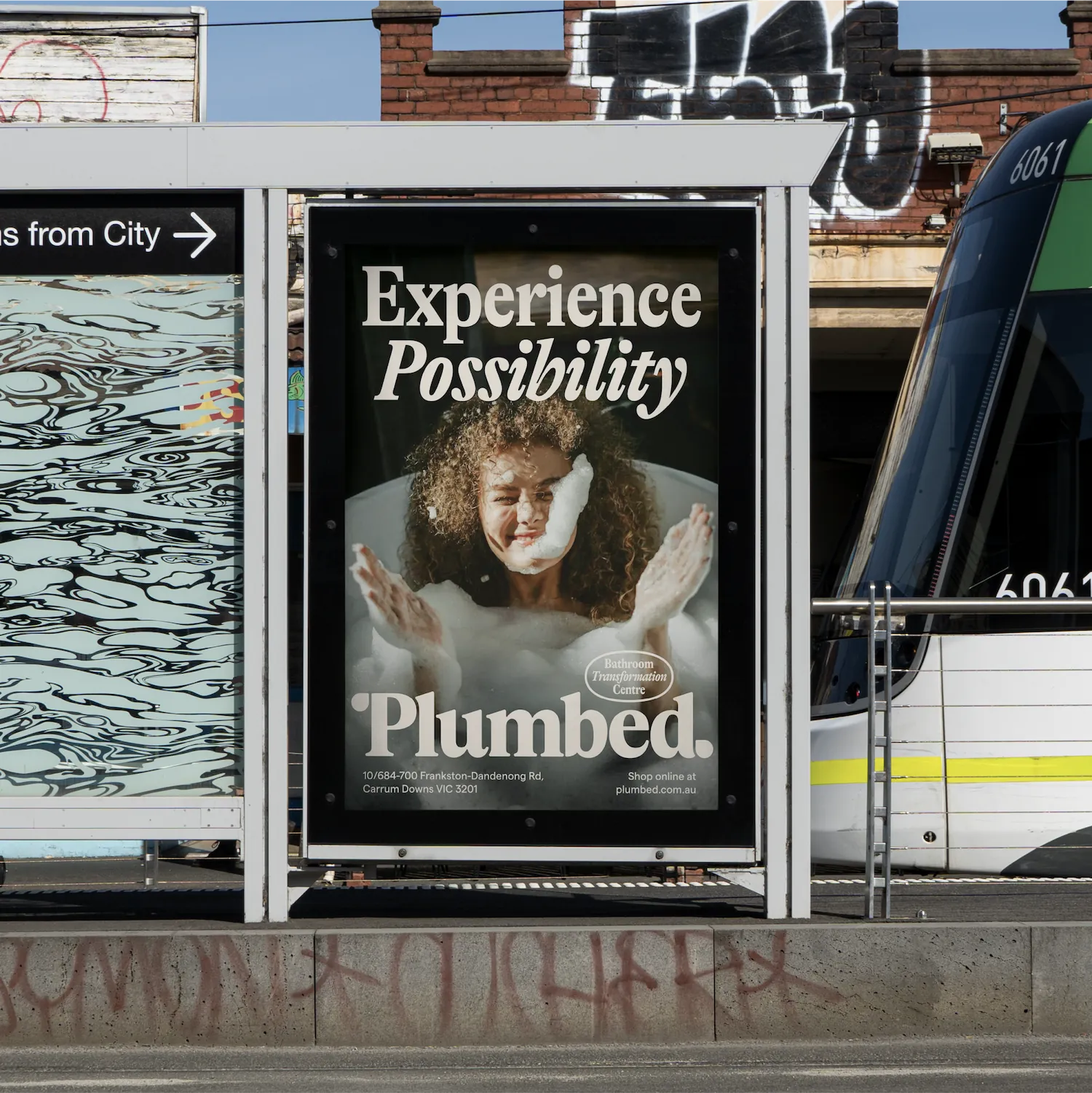
New ownership changed the ambition: from a local, price-led retail operation to a value-led business built on range and experience. The diagnosis was clear. This wasn't a technical problem or a facelift situation. The business model was changing, and the brand had to change what it meant.
The strategic move was category design. Instead of positioning Plumbed as a place to buy parts, we positioned it as a transformation centre: a place where you go from zero, to an idea, to a complete fit-out, with established trade relationships and everything you need under one roof. Because nobody actually wants a bath, a shower or a tap. They want the transformed bathroom at the end. While the rest of the market sold baths and prices, Plumbed sold the finish line. This is worth naming: it was an offensive rebrand. Nothing was broken enough to force the change. There was a category waiting to be claimed, and Plumbed moved first.
The question everyone asks about a repositioning like this: didn't you lose the old customers? Some, and it didn't matter. Customers who respond primarily to price are price-loyal, not brand-loyal. They were always going to follow the next discount out the door. And in a category where most consumers renovate a bathroom once a decade, the game was never repeat purchase; it was acquisition. What we protected carefully instead were the trade partners, who are repeat customers.
The results compounded: a new customer base aligned to the value proposition, trades who fit the brand, pricing power that's increased over time, expansion into online retail, and stronger supplier relationships, which unlocked larger discounts and better wholesale pricing. That last one never makes the case study PDF. A stronger brand improved their buying position, not just their selling one.
The same pattern holds at national scale. When Qantas updated the flying kangaroo in 2016, only the fifth change to the tail since 1944, designed by Marc Newson in partnership with Sydney agency Houston Group, the identity came after years of capital investment in the actual experience: new Dreamliners, rebuilt lounges, upgraded service. The design team then spent more than a year making the identity work across over 200 applications. Discipline at both ends: a genuine business reason to change, and implementation treated as the main event.
The City of Melbourne's 2009 rebrand by Landor is the other local benchmark, and a masterclass in brand architecture. An audit found the fifteen-year-old 'leaf' logo outdated and the organisation fragmented across 27 sub-brands. The bold 'M' unified everything into one flexible masterbrand, for a reported total of just under US$200,000. It copped plenty of criticism at launch; fifteen years on, it's cited worldwide as a landmark of dynamic identity design. Rebrands are judged in years, not news cycles.
Internationally, Burberry and Mailchimp tell the same story: product, distribution and experience overhauled first, the visual identity arriving as the final, visible expression of a change that had already happened.

Keeping Customers Through a Rebrand
The fear that stops most businesses from rebranding isn't cost. It's losing the customers they already have. It's a legitimate risk, but more manageable (and sometimes more acceptable) than most owners think.
Work out whether the customers you'd lose are worth keeping. If your current brand attracts purely price-driven buyers and your strategy is to move up the value curve, some churn isn't failure. It's the strategy working.
Bring people along, don't surprise them. Tell customers what's changing and why, before it changes. Change lands badly when it happens to people rather than with them.
Launch internally first. Your team hears it before the market does. They'll field every "what happened to the old logo?" question, and their confidence in the answer is what makes customers comfortable.
Protect your highest-frequency relationships. For most businesses that's not the one-off consumer. It's the trade partner, the repeat account, the referrer. White-glove treatment through the transition.
Switch everything over fast. The most damaging phase is the awkward period where old and new brands coexist. At minimum, all digital channels flip simultaneously; physical assets can trail on a planned timeline.
Don't drop the ball operationally. Customers will forgive a new look. They won't forgive worse service arriving with it.
How to Measure a Rebrand
You can't call a rebrand successful if you never defined what success meant. The measurement conversation belongs at the start: what's important to this client, what's important to their audience, and what goals does the exercise serve? The metrics flow from those answers, not from a standard dashboard. Anything else is an agency measuring its own product rather than your outcome.
The signals fall into two buckets.
Qualitative: brand sentiment, meaning the words, feelings and intent people use about the new brand. Audience feedback through conversations and surveys. Partner feedback. For businesses with important trade or referral relationships, what your partners say is often the earliest and most honest read you'll get.
Quantitative: branded search volume, direct traffic, enquiry volume and, just as important, enquiry quality and conversion rate. Over a longer horizon: repeat purchase and loyalty, engagement across channels, and re-engagement of audiences that had gone quiet. Commercial markers matter too. In Plumbed's case, success showed up as pricing power, new channels and better wholesale terms, none of which appear on a brand tracker.
When to expect signal depends on context. Some effects show almost immediately: the moment the refreshed website goes live you'll see movement in engagement and conversion. Beyond that, a big go-to-market push pulls market response forward, while a quiet rollout accumulates slowly. Consumer-facing brands see signal sooner; B2B brands with long sales cycles see impact land later, sometimes a full cycle after launch. Judge the rebrand against your sales cycle, not the calendar.
The Cost of Rebranding a Business (and How Long It Takes)
Let's address the question everyone asks but few answer honestly: what does rebranding actually cost?
It varies enormously with context: the scale of the business, the requirements, the applications involved and the size of the teams. As indicative starting points for the Australian market: a brand refresh for a small business typically starts from $10,000 to $30,000. A comprehensive rebrand for a mid-sized company, covering strategy, identity design, guidelines and initial implementation, starts from $30,000 and runs to $100,000 or more. Enterprise rebrands with global rollouts cost millions. Treat these as "from" prices, not quotes.
Timelines follow the same logic. A brand refresh generally takes two to six months end to end, including rollout, client rounds and content production. A full rebrand with a large existing footprint could range closer to six to twelve months. When there are vehicle fleets, uniforms, building signage and wayfinding to replace, the rollout is a logistics project in its own right. Anyone quoting six weeks is quoting the design phase and hoping you won't notice.
And here's the thing about cost: the design and strategy fees are often the smaller part. The real investment is implementation. Website, collateral, signage, packaging, training. For businesses with significant physical presence, implementation can cost several multiples of the design fee.
This is why the strategy matters so much. A $50,000 rebrand that's strategically sound delivers far more value than a $150,000 rebrand that looks beautiful but solves nothing. The cheapest rebrand is one you only have to do once. Budget for the full journey from the start.
Working with a Rebranding Agency
Can you rebrand in-house? Technically, yes. Should you? Usually, no.
Rebranding requires strategic thinking, creative capability and objective perspective that's very difficult to achieve internally. Your team is too close to the brand, with opinions and blind spots that are almost impossible to set aside. An agency brings fresh eyes and a structured process that keeps things moving rather than circling.
When choosing rebranding services, look for:
They challenge your diagnosis. The biggest one, and the rarest. If you say "we need a rebrand" and the agency simply agrees and sends a proposal, be suspicious. A good agency wants to hear, in your own words, why you think you need it, then pressure-tests whether that's actually the problem. Agencies that never push back are selling you their process, not solving your problem.
Strategy-first approach. If an agency leads with "what style do you like?" rather than "what business problem are we solving?", keep looking.
Process transparency. A good agency can explain exactly how they work: each stage, what they need from you, what decisions you'll make and when. Vague and mysterious is a red flag.
Relevant experience. Have they rebranded businesses similar to yours? Can they show the thinking behind the work, not just the pretty pictures? Case studies that explain the strategic rationale beat a portfolio of logos.
Implementation support. The best agencies help you plan and execute the rollout across every touchpoint. A brilliant identity inconsistently implemented is worse than a mediocre one applied perfectly.
Common Rebranding Mistakes
We've seen the same mistakes come up repeatedly. And when rebrands fail publicly, they fail expensively.
Australia produced one of the most famous failures of them all. In 2009, Kraft crowdsourced a name for its new Vegemite spread, drew more than 48,000 entries, announced the winner ("iSnack 2.0") during the AFL Grand Final broadcast, and abandoned the name just four days later under nationwide ridicule, re-polling the public to arrive at "Cheesybite." It's now a Harvard Business School case study. The instructive part: the process looked customer-led right up until the decision that mattered, when a shortlist went to a boardroom instead of back to the audience. Overseas the pattern repeats. Gap's 2010 logo was retired within a week, Tropicana's 2009 packaging redesign coincided with a sales slump of roughly 20% before reverting, and Royal Mail's "Consignia" was scrapped inside eighteen months. Different businesses, same root cause: change that wasn't anchored in a real strategic problem and destroyed equity built over decades.
The mistakes behind failures like these are remarkably consistent:
Rebranding off a misdiagnosis. If the business problem isn't clearly identified, and worth solving, the rebrand just relocates the confusion.
Chasing the same "new" as everyone else. The convergence trap: rebranding from "old" to "modern and playful" at the same moment every competitor makes the identical move.
Starting with design. Reverse the strategy-then-design order and you get a brand that looks different but means nothing.
Promising what the operation can't keep. A rebrand raises expectations the product and service have to meet. If the delivery contradicts the story, the rebrand accelerates the damage rather than fixing it.
Ignoring existing brand equity. Your current brand has value even if you're frustrated with it: recognition, trust, emotional connection. Build on the brand equity, don't destroy it. Evolution, not amnesia.
Underestimating implementation. Rolling out consistently across every touchpoint is where most rebrands stumble. Budget for it. Plan for it.
Forgetting your team. If employees learn about the rebrand the same day as customers, you might have a few interesting emails. Internal alignment comes before external launch.
Expecting overnight results. Change always creates friction. Melbourne's 'M' was widely criticised at launch and is now regarded as one of the most influential identity systems of its era. Measure results over months and years, not days and weeks.
Rebranding and Brand Strategy
A distinction worth making: rebranding is a project. Brand strategy is ongoing.
A rebrand is a moment in time, a deliberate intervention in how your brand presents itself. Brand strategy is the continuous work of building, managing and evolving your brand. The rebrand is the renovation; brand strategy is the ongoing maintenance.
The best rebrands are grounded in brand strategy, the result of thinking about where the business is going and what the brand needs to do to get there. Rebrand without a strategy to support it and you'll be back in the same position in a few years, with a brand that's drifted out of alignment again. The rebrand fixes the immediate problem. The strategy prevents it recurring.
Time for a Rebrand?
If you're reading this far, something about your current brand probably isn't working. Or something about your market is moving and you can see it before your competitors do. Either way, the first step isn't choosing colours. It's getting the diagnosis right. Is the problem technical, relevance, or strategy? Is it worth solving? Or is there no problem at all, just a category waiting to be claimed?
We work with businesses at every stage of this decision, from "we're not sure if we need a rebrand" to "we know we need one and we need it done right." Sometimes the answer is a full rebrand. Sometimes it's a refresh. Sometimes it's just a brand audit to see where you stand. That's exactly what we help figure out. And if we think you don't need a rebrand, we'll tell you that too.
Rebranding is the process of changing how a business presents itself to the world. It can include changes to the name, visual identity, brand strategy, messaging and voice. At its core, rebranding is about closing the gap between who your business is now and how people perceive it. It ranges from a simple brand refresh (updating visual elements) to a full rebrand (new name, identity and positioning).
There are three main types of rebranding. A brand refresh updates visual elements like logo, colours and typography while keeping the core identity intact. A partial rebrand makes more significant changes to the visual identity and messaging but preserves the name and fundamental positioning. A full rebrand involves changing everything - name, identity, positioning and strategy. The right type depends on whether the business has fundamentally changed or just needs a visual update.
The cost of rebranding varies significantly depending on scope. A brand refresh for a small business might cost $10,000 to $30,000. A comprehensive rebrand for a mid-sized company typically runs from $30,000 to $100,000 or more. However, the design and strategy fees are often the smaller part of the total investment. Implementation costs - updating your website, collateral, signage, packaging and digital presence - can cost several multiples of the design investment.
A solid rebranding process follows a sequence: discovery and brand audit, strategy development, identity design, brand guidelines creation, internal launch, external launch, and post-launch monitoring. The most important principle is that strategy comes before design. Jumping straight to visual changes without understanding the business problem you're solving is the most common rebranding mistake.
Common triggers for rebranding include business evolution (outgrowing your original brand), mergers and acquisitions, reputation challenges, market repositioning, an outdated visual identity, or international expansion. The key question is whether your current brand is helping or hindering your business goals. If it's creating confusion, limiting your growth or no longer reflecting what you do, it may be time to rebrand.
While it's technically possible to rebrand in-house, working with a rebranding agency is usually the better approach. Internal teams are too close to the brand to be objective. A good agency brings strategic thinking, creative capability and a structured process. When choosing an agency, look for a strategy-first approach, process transparency, relevant experience with similar businesses, and implementation support beyond just the design phase.
No. A logo change on its own is a redesign, not a rebrand. A brand lives in the minds of customers, in the associations they've built through every interaction with your business. Rebranding means changing those associations, which usually requires shifts in positioning, messaging and experience. A new logo is often part of a rebrand, but it's the delivery mechanism, not the substance.
A brand refresh typically takes two to six months end to end, including rollout and content production. A full rebrand for a business with a large physical footprint (vehicle fleets, signage, uniforms, wayfinding) is closer to twelve months, because the rollout becomes a logistics project in its own right.
Some churn is possible, but it's manageable, and sometimes strategic. If your rebrand moves the business up the value curve, losing purely price-driven customers may be the strategy working, not failing. Protect your highest-frequency relationships (trade partners, repeat accounts), communicate the change before it happens, launch internally first, and switch all digital channels over simultaneously to avoid a confusing transition period.
It depends entirely on the diagnosis. Rebranding is a good idea when it solves a clearly identified problem (technical, relevance or strategy) or captures a genuine opportunity, like claiming a new category before competitors. It's a bad idea when it's driven by boredom, imitation or misdiagnosis, because it spends money and brand equity without changing how the business competes. The question isn't whether rebranding is good or bad. It's whether you've correctly identified what needs to change.

Marcel McCarthy is the Creative Director at ONETOO. He helps ambitious brands turn strategy into clarity — and clarity into action. Known for asking hard questions, dodging trends, and making bold ideas feel obvious (in hindsight).