There's a question every business eventually faces, usually when it's already too late to answer it easily: why do customers choose us over a competitor that's cheaper, faster or just louder?
The answer, more often than not, comes down to brand equity.
Brand equity is the accumulated value a brand holds in the minds of its customers: the recognition, trust, associations and loyalty that make people choose it, pay more for it, and return to it when a cheaper or alternative value offering exists.
It's one of the most important concepts in brand strategy, and one of the most misused. Here's the part most articles on this topic won't tell you: brand equity is not something you control directly. It's the outcome of a properly defined brand, delivered consistently. Chasing it is a bit backwards. But understanding it changes how you make decisions about pricing, rebranding and where your marketing money actually goes.
What is Brand Equity?
Brand equity is the commercial and perceptual value a brand adds to a product or service beyond its functional attributes. Same product, same specifications, different name on it: the gap in what people will pay, and how readily they'll choose it, is equity. Which is why naming is an equity decision, not a creative one.
Here's the thing though. Almost nobody outside marketing departments uses the term. Brand equity is an insider's word, a little academic at best. Business owners talk about their brand being recognisable, about goodwill, about people having positive associations with the name, about customers who keep coming back. All of that, loosely bundled, is what they mean. And they're not wrong. Those are the raw materials of equity; the term is just the account they all get deposited into.
The concept matters because a brand lives in the minds of your customers, not in your asset register. Equity is the measure of how much value has accumulated there.
Brand Equity vs Brand Value
The two get conflated constantly, usually when a business changes hands.
Brand value is financial: the monetary figure a brand adds to a company's worth. It's what analysts calculate when they value a business for sale or acquisition. Aaker himself describes the method plainly: estimate the business's future earnings, then have knowledgeable people judge how much of that the brand is responsible for. Note the word judge. Even the financial side of this rests on an informed, subjective estimate, not a formula.
Brand equity is perceptual: the associations, trust and behaviours that live with customers. It's the cause; brand value is the effect. Strong equity creates pricing power, retention and resilience, and those flow through to whatever number an acquirer will pay.
If you're a small or mid-sized business, equity is the one you can actually influence. The valuation takes care of itself downstream.
Why Brand Equity Matters
Brand equity is not a soft metric. Brands with high equity command premium prices, and their customers are less price-sensitive, more forgiving of the occasional misstep, and more likely to refer. Acquisition costs less because loyalty and word of mouth do part of the work. New offers launch to an audience already predisposed to trust them.
The inverse is just as real. Low equity means competing on price and convenience, and that race only ends one way. Margins erode, retention gets fragile, and every competitor with a slightly lower price can pull customers away.
Equity is the moat. It's also one of the few competitive advantages that genuinely can't be replicated quickly, because it only accumulates through time and consistency. A competitor can copy your offer in a quarter. They can't copy fifteen years of kept promises.
Brand Equity Examples: Qantas, Bunnings and Holden
Qantas
Ask someone to name an Australian airline and the answer is nearly always Qantas. That saturation of awareness didn't come from the planes. It came from decades of storytelling that fused the brand to Australian identity itself: the Spirit of Australia, the choirs, family reunions in arrival halls. It's reinforced by a hard fact with real emotional weight: Qantas has never lost a jet aircraft to a fatal accident, and people feel that when they fly.
Contrast Virgin Australia, a capable airline whose brand is far more associated with Richard Branson than with Australia. Both fly the same routes. Only one gets to borrow the emotional load of the word home.
Qantas equity is also a lesson in resilience. The airline has taken genuine reputational hits in recent years, from outsourcing decisions to executive pay controversies, and the brand has continued to perform. That's what a deep equity account buys you: the ability to make withdrawals and survive them. It's a privilege earned over a century, not a birthright.
Bunnings
Bunnings is arguably the best brand equity story in Australian retail, and the proof came when someone tried to compete with it.
The equity wasn't built on price alone. It's in how the offer is framed: the no-frills warehouse, open racking, low-cost everyday accessibility. There's no superiority in the hardware store. Tradies and first-time renovators shop the same aisles, and both feel like the place is for them. The advertising puts staff forward, locals helping locals, rather than a faceless corporate voice. And the sausage sizzle out the front turned a hardware run into something the whole family doesn't mind doing. All of it compounds into habit, and habit into loyalty.
Then Woolworths spent seven years and more than $3 billion learning what that loyalty was worth. Masters had good products, good distribution and serious backing. What it didn't have was a compelling answer to the question every shopper silently asked: why would I go anywhere else? To the customer it was the same store with a different name and different colours, up against a brand people had positive associations with and a habit of visiting. Without genuine differentiation, Masters was competing against equity with a catalogue. Every store closed by the end of 2016.
Holden
Holden stopped manufacturing in Australia in 2017 and the brand was retired entirely in 2020. The equity outlived both events.
Holden's value was never really about getting from A to B. It was an Australian story people grew up inside: the Holden versus Ford rivalry, Bathurst, a car as an identity statement about performance and Australian ingenuity. People placed part of themselves in what they drove. That's why classic Holdens still command strong prices and why the badge still means something to people who will never buy one again. Equity can persist after the product is gone, because it never lived in the product. It lived in the story.
One more pattern worth naming from that example: the bigger and more considered the purchase, the more the buyer wants the equity to hold. Someone who buys a European car may never buy another one, but they carry the association for a decade. They still want to love the car. Ongoing purchases build equity through repetition; big one-off purchases demand it up front.
Aaker's Brand Equity Model
The most cited framework for understanding brand equity comes from David Aaker, whose 1991 book Managing Brand Equity defined it as a set of assets and liabilities linked to a brand that add to, or subtract from, the value it provides.
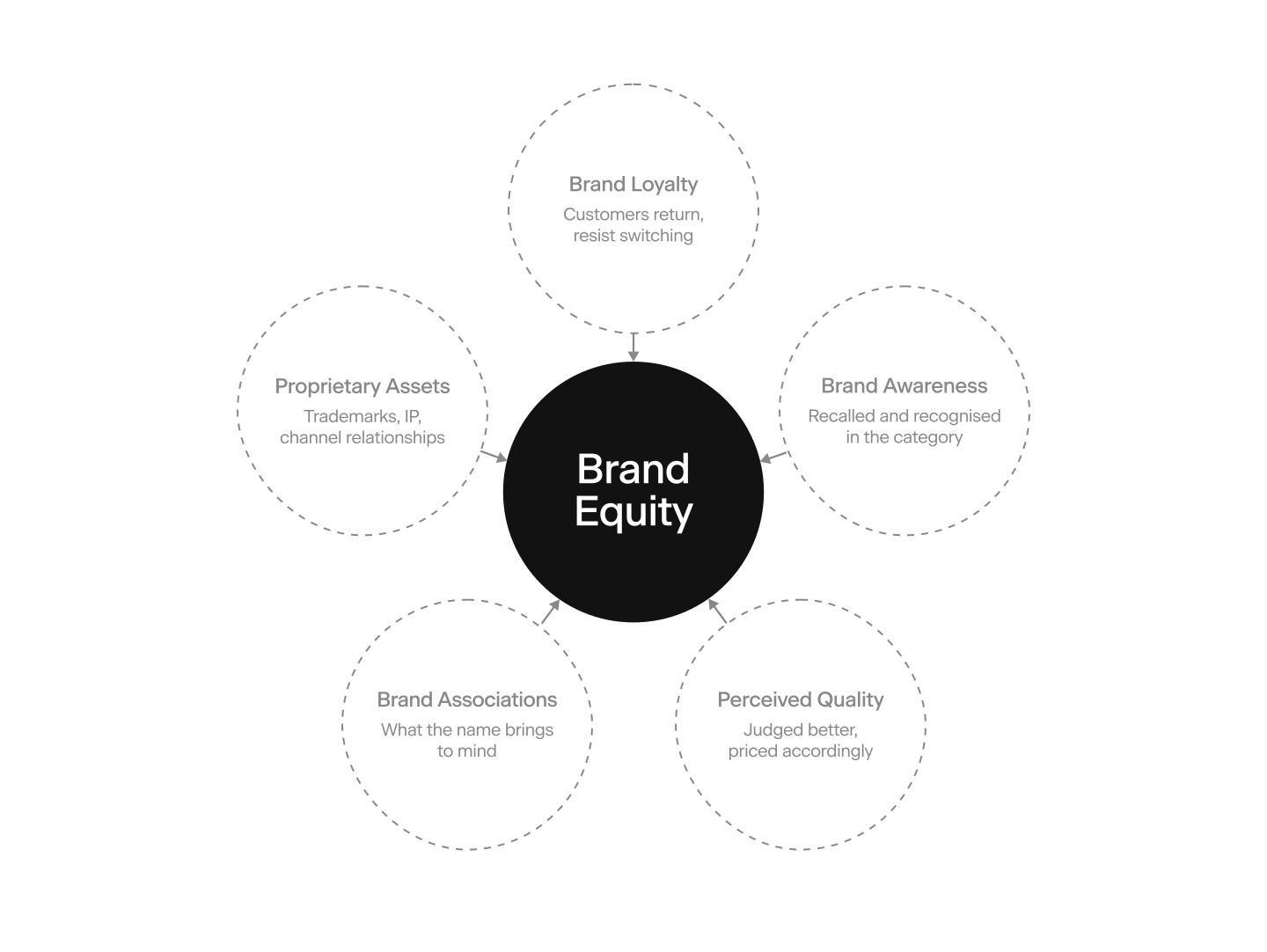
Aaker's model breaks equity into five components:
- Brand loyalty. The degree to which customers return and resist switching. Loyalty is equity expressed as behaviour, and it's the component with the most direct commercial payoff: lower churn, lower acquisition cost, word of mouth.
- Brand awareness. Whether people recall and recognise the brand within its category. Awareness is the entry ticket; nothing else in the model works without it.
- Perceived quality. Whether the brand is judged as better, independent of whether it measurably is. Perceived quality is what pricing power rests on.
- Brand associations. Everything the name brings to mind: attributes, feelings, use occasions, the company it keeps. Bunnings means the sausage sizzle as much as it means timber.
- Proprietary assets. Trademarks, intellectual property, channel relationships. The legal and structural moats around the rest.
Keller's Brand Equity Model (CBBE)
Kevin Lane Keller's customer-based brand equity model, usually drawn as a pyramid, describes equity as something built in stages, in the customer's head, in order.
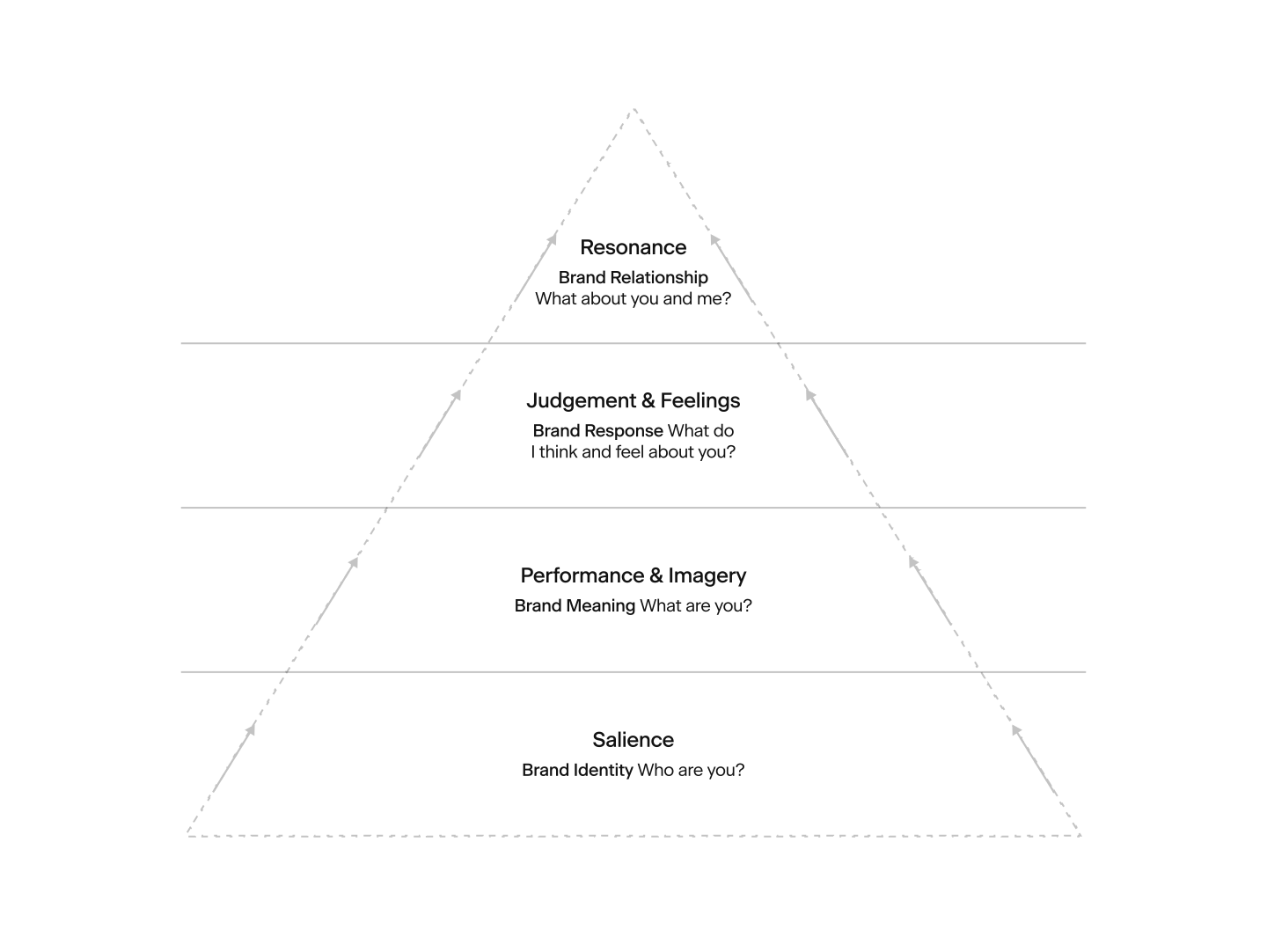
The four levels, each answering a question the customer is silently asking:
- Salience: who are you? The customer knows the brand exists and what category it plays in.
- Meaning: what are you? Split into performance, whether the product delivers, and imagery, what using it says and feels like.
- Response: what do I think of you? Judgments and feelings form. This is where perceived quality and emotional connection live.
- Resonance: what about you and me? The peak: active loyalty, a sense of community, customers who advocate without being asked.
The pyramid's honest message is that you can't skip levels. A brand chasing advocacy while its product performance wobbles is building the top floor on sand.
Aaker vs Keller: Which Model Should You Use?
Here's our honest position, having sat with both across client work: the models are abstractions. They're ways to communicate and measure something inherently intangible, not machinery you install. Whether either is useful is case by case. It depends on the client, the industry, whether the business is B2B or B2C, how the sales process actually works and where value accrues over time. A B2B firm with forty customers who all know the principals personally has real equity; almost none of it maps neatly to an awareness pyramid built for consumer goods.
Use Aaker when you need to audit what a brand has: an asset stocktake, useful ahead of a valuation or rebrand. Use Keller when you need to diagnose where the customer relationship stalls: a journey, useful for setting marketing priorities.
| Aaker's Model | Keller's Model (CBBE) | |
|---|---|---|
| What it is | A stocktake of brand assets and liabilities | A staged customer journey toward loyalty |
| Structure | Five components: loyalty, awareness, perceived quality, associations, proprietary assets | Four levels, six blocks: salience, performance and imagery, judgments and feelings, resonance |
| Best for | Auditing what a brand has before a valuation or rebrand | Diagnosing where the customer relationship stalls |
| Typical use | Pre-rebrand stocktake, sale or acquisition prep | Setting marketing priorities along the journey |
| Blind spot | Static: describes the balance, not how to build it | Built for consumer goods; maps loosely to B2B |
You may also come across the Brand Asset Valuator and BrandZ. Both are proprietary research products, built by Young & Rubicam and Kantar respectively, that benchmark brands against large consumer datasets. They're genuinely useful if you're a multinational buying the research. For everyone else they're trivia: you don't apply them, you purchase them.
How Brand Equity is Built
Equity doesn't arrive with a launch. It accumulates, and the mechanism is simple even though the execution isn't: every interaction either deposits into or withdraws from the account.
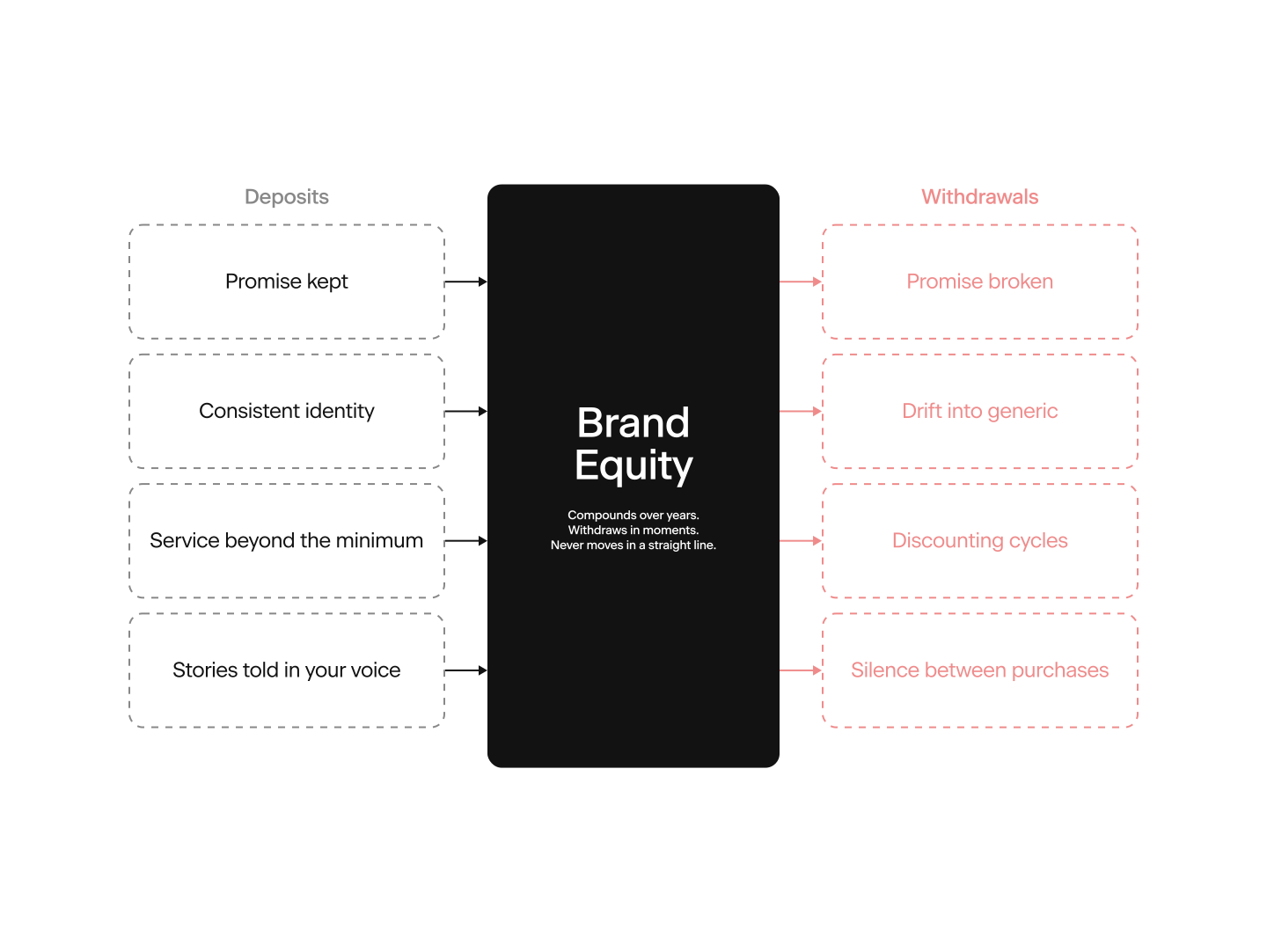
Deposits come from the promise kept. A product that does what was claimed. A team member who goes beyond the minimum. Communication that's honest and distinctively yours. This is worth sitting with, because it means equity is built in places no marketing plan reaches. Think of a shop where one person behind the counter consistently makes customers feel seen, understood and helped to a good outcome. That person is building brand equity, transaction by transaction, entirely outside the structured campaigns. For most small and mid-sized businesses, more equity lives in that day-to-day nuance than in any advertising.
Consistency is the multiplier. The same positioning expressed across every channel and interaction, so each deposit lands in the same account instead of scattering across several. Without a clear position, a business still accumulates impressions, but customers can't attach them to anything coherent. They remember the experience and forget the brand.
And a warning from the other direction: small businesses often over-index on the visual assets, believing the value lives in the logo or the colours. Associations with brand identity elements can be genuinely strong, but they're the label on the account, not the balance in it. A distinctive identity with no kept promises behind it is equity theatre.
How Brand Equity Erodes
Erosion has two speeds.
The fast one is the broken promise: a quality failure, a trust breach, an experience that contradicts what the brand claims. Years of deposits can be withdrawn in a single public moment.
The slow one is drift, and it's the one we see far more often. The positioning that once felt sharp goes generic. The messaging gets replaced by safe, templated language. Nothing dramatic happens; the brand just becomes gradually invisible, and the equity quietly leaks out.
There's a third mode worth naming because it's self-inflicted: discounting your way out of your own promise. We watched an e-commerce brand with a premium positioning, one we won't name, get caught in a discounting cycle. Each sale moved units, and each sale also taught customers that the full price was negotiable. Over time people assimilated to the discounted price as the real one, and stopped paying full price at all. The revenue tactic was making structural withdrawals from the equity account. You can promote yourself into death: the brand still exists, but the premium it was built to command is gone.
Brand Equity Has Drawdowns. That's Normal.
Here's a frame we find more useful than most of the measurement literature: brand equity behaves like a market. Nothing moves up in a straight line. Campaign to campaign, sentiment rises and falls, finds a floor, sets a new high. Over years, a well-run brand builds equity far beyond the commodity value of what it sells, but the path there includes drawdowns, and a drawdown is not the same thing as erosion.
2024 and 2025 supplied two spectacular public examples. Jaguar's rebrand attempted a radical elevation away from everything the marque had historically been, and the backlash was global. Cracker Barrel, the American restaurant chain, simplified its logo and reversed the decision within eight days after a customer revolt and a roughly US$100 million dip in market value. In both cases, people were rebelling against change that felt like a loss of character and soul. They had positive associations with what was, things they liked were being cut, and they couldn't see why.
The honest reading is more complicated than the outrage suggests. Both were struggling businesses that genuinely needed to change to survive, and much of the loudest criticism came from people who weren't active customers anyway. That's the strange dynamic of equity at scale: the bigger the brand, the more the public feels ownership of it, and the more any change gets contested by the crowd rather than the customer base.
Two takeaways for businesses a few orders of magnitude smaller:
- Sensitivity scales with size. A local or state-level business making a bold change won't face a national pile-on. Your equity lives with a few hundred or a few thousand customers, not with commentators. That's freedom; use it.
- Bold moves polarise, and that's survivable. Some customers will be put off; others will lean in and value you more. What decides the outcome is nerve: a management team confident enough in the change to hold fast and keep telling the story, rather than folding at the first noisy week. Keep what people genuinely hold sentiment towards, but tell those stories in new ways.
How to Measure Brand Equity (Without a Research Platform)
Most of what ranks for this topic is written by enterprise research companies, and their answer to measurement is, unsurprisingly, buying enterprise research: brand tracking surveys, attribute studies, share-of-voice panels. If you're a multinational, that's the right tool. If you're a $1 million to $5 million business, it's the wrong advice, and there's no single formula that spits out your equity as a number anyway.
What you can do is triangulate. Look across your channels and your history and ask the only question that matters: how and why do people choose us?
- Branded search volume. Are more people searching your name this year than last? That's awareness you didn't pay for at the moment of intent.
- Direct traffic and repeat rate. People who come straight to you, and come back, are demonstrating equity with their behaviour.
- The competing-quotes signal. In service businesses, listen for we didn't talk to anyone else. Customers who don't comparison-shop are telling you your equity closed the sale before you turned up.
- Referral share. What proportion of new work arrives through word of mouth? Referrals are equity being spent on your behalf.
- Price premium held. Can you charge above the category average without volume falling away? Pricing power is the most commercial expression of equity there is.
- Context. Read all of it against your industry. A B2B brand will always show lower raw awareness than a consumer brand, but B2B markets are smaller and more concentrated, so a high standing among forty buyers can be worth more than mild recognition among forty thousand.
Trend these over time rather than obsessing over any single reading. The question is never what's our score. It's are we building, holding or eroding.
When Brand Equity is the Wrong Frame
An honest boundary: if you're a startup doing something new, brand equity is mostly the wrong thing to think about. You don't have any yet, and you won't get it by wanting it. Equity accrues; it isn't installed. Get the fundamentals right, the position, the promise, the product, and let time do the compounding.
The moment equity genuinely belongs on the table is when you're considering a rebrand or a major overhaul of your communications. That's when the vested value in the existing brand becomes a real asset you can protect or destroy, and when a proper brand audit earns its keep: it's the stocktake of what's actually in the account before you decide what to change. Jaguar and Cracker Barrel are what it looks like to get that accounting wrong, or to get it right and misjudge the nerve required.
The same applies to pricing decisions, discounting especially. Every discount is a withdrawal. Sometimes it's worth it. It should never be unconscious.
The Real Test
A useful thought experiment. If your brand vanished tomorrow, how quickly would your top ten customers replace you, and how much would they miss you?
If the honest answer is quickly, and not much, the value you deliver is functional and replicable, and you're one competitor away from a price war. Strong equity means they'd feel the loss: a benchmark gone, a trusted default gone, a brand they'd have to actively work to replace.
That irreplaceability doesn't come from pursuing brand equity. It comes from defining what your brand stands for, keeping the promise, looking after people, and telling stories that invite customers into your point of view, for long enough that the value compounds. Do that and the equity accrues on its own. It's the outcome of brand strategy done properly, not a project you run alongside it.
If you want to define the brand worth compounding, that's what we do.
Brand equity is the extra value a brand carries in the minds of its customers: the recognition, trust, associations and loyalty that make people choose it and pay more for it. Two businesses can sell a near identical product, and the one with stronger equity will win the sale, hold a higher price and keep the customer longer.
Brand equity is perceptual: the trust, associations and loyalty held by customers. Brand value is financial: the dollar figure a brand adds to a company, typically estimated during a sale or acquisition. Equity is the cause and value is the effect; strong equity flows through to pricing power and retention, which is what an acquirer ultimately pays for.
No single formula exists. Even brand valuation, the financial side, rests on estimating future earnings and then judging how much of them the brand is responsible for, which David Aaker himself describes as a subjective estimate. For most businesses the practical approach is triangulation: branded search volume, repeat and referral rates, and the price premium the brand holds.
Indirectly. Equity accrues when a clearly positioned brand keeps its promise consistently over time: product quality, service beyond the minimum, communication in a distinctive voice. Every interaction is a deposit or a withdrawal. Define the position, keep the promise and let time compound the balance.
Track behavioural signals over time: branded search volume, direct traffic, repeat purchase rate, the share of new business arriving by referral, and whether you can hold prices above the category average. In service businesses, listen for customers who did not seek competing quotes. The trend matters more than any single reading.
The two most used are Aaker's model, which breaks equity into five assets (loyalty, awareness, perceived quality, associations and proprietary assets), and Keller's customer-based brand equity pyramid, which describes four stages from salience to resonance. Both are abstractions of something intangible: useful for auditing and diagnosis, not machinery to install.
Early on. A startup doing something new has no equity yet and will not get it by pursuing it; the fundamentals of positioning, promise and product matter far more. Equity properly enters the conversation when considering a rebrand, a major overhaul or pricing changes, because that is when vested value can be protected or destroyed.

Marcel McCarthy is the Creative Director at ONETOO. He helps ambitious brands turn strategy into clarity — and clarity into action. Known for asking hard questions, dodging trends, and making bold ideas feel obvious (in hindsight).